
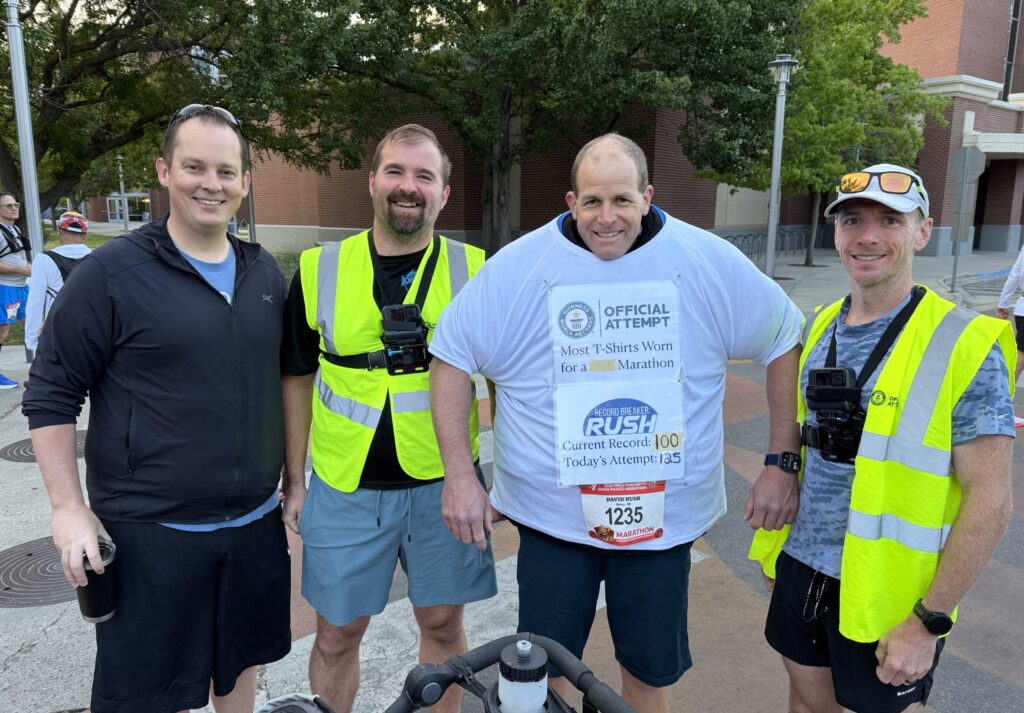
This marathon was 12 years after my first (and once sworn to be last) marathon.. It also became a desperate, high-stakes battle against the limits of human physiology. When I set out to claim the record for the most t-shirts worn during a marathon, I was just trying to beat a number. Then I ended up trying to reconcile a history of physical failure, near-catastrophic injury, and years of training.
The Weight of History
The current Guinness World Records title for the most t-shirts worn during a marathon sat at 100 shirts. I decided (*decided is used loosely here) to aim for 125 (after narrowing from nearly 150, to 139, to 133 day of to 125 while putting them on!). That might sound like a simple, manageable goal, but when you are talking about 125 layers of fabric (and 250 between the arm and side!), you aren’t just wearing clothes. I are wearing a pressurized suit that restricted my lungs, constricted my blood flow, and altered my mechanics.
My history with the half-marathon version of record is written in scars and near-misses. In 2019, while breaking the half-marathon record with 111 shirts, I pulled my shoulder out of place (it hurt for months). A 2023 attempt ended when the fabric stacked so high around my throat that it cut off the blood flow to my brain, forcing me to abandon the effort before I started the race.
Last year, I successfully hit 137 shirts for a half-marathon. In the heat of that victory, I felt invincible. I thought, “If I can do this for 13 miles, I can easily double it.” That was a classic case of pride coming before a very painful fall.
Preparation: More Than Miles
To stand a chance at the 26.2-mile distance, I had to overhaul my conditioning. I didn’t just train by running. I trained by simulating the absolute worst-case scenario. I ran the Boise Greenbelt wearing multiple winter coats, a heavy waterproof raincoat to lock in the humidity, and a 30-pound backpack.
To bolster my stamina and grit, I supplemented those runs with 10 hours of competitive pickleball every week (ok this was more because it was fun and I called it *training*). This record isn’t just about endurance. It’s about enduring while you are being crushed. I also tackled a separate record for climbing 10,000 stairs, which taught me the specific type of mental exhaustion that comes with long-term, high-intensity repetition.
The Race: A Medical Rescue
Race day at the Famous Idaho Potato Marathon was a sobering reminder that you can prepare for everything except the unexpected. I started the race with a team of support runners, but by Mile 19, the situation had shifted from a record attempt to a medical emergency.
-
The Overheating: My body was holding so much heat that I couldn’t hold down food or energy gels. My stomach had knotted into a ball of nausea, and I was dangerously close to heatstroke.
-
The Missing Supplies: We ran out of ice, and we had lost our second pack of electrolytes. Without them, my muscles were on the verge of total shutdown.
-
The Golf Course Save: I had to veer off the course onto a nearby golf course. Patrick, one of my support runners, sprinted into the pro shop to beg for emergency ice. That ice was the only reason I didn’t end up in the hospital.
The Takeaways: Why I Do It
When I crossed the finish line at 5 hours, 54 minutes, and 50 seconds, I had just over five minutes of breathing room before the record would have been invalidated (6 hour Guinness cutoff even though the race itself had a 9 hour cutoff). I collapsed into the chair because I had nothing left.
The process of peeling 125 shirts off my body felt like an exorcism. My skin was red, raw, and crisscrossed with bloody, five-inch-long chafing marks where the bottom of the shirts had ground against my skin for six hours. My back was indented from the constant pressure of 43 pounds of clothing.
I don’t do this because I like the pain. I do this because I believe in the power of a growth mindset. I want to show students that you don’t have to be born with a specific talent to achieve the impossible. You just have to be willing to prepare, adapt, and refuse to quit when the walls start closing in. Resilience isn’t about being strong all the time. It’s about being strong enough to find the next step when your body is telling you to lay down.
If you are facing your own “125-shirt” challenge, don’t look at the whole marathon at once. Just look for the next bag of ice. Just take the next step. You’d be surprised what you can achieve when you refuse to let the clock beat you.
Pingback: Watch: Idaho man runs marathon while wearing 125 T-shirts – Move Forth Curated News
David, That was incredible. I have run several Marathons including Boston but what you accomplished is incredible. Running a full marathon with an extra 43 Ibs is amazing. Smart thinking of the pro shop with ice to save the day.